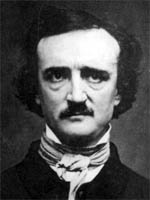
Alone By: Edgar Allan Poe
  • Home
  • Theme and Subject
  • Tone
  • Imagery
  • Lyric
  • Allusion
  • Rhyme/Rhyme Scheme
  • Point of View
  • Persona
  • Diction
  • Assonance
  • Form
  • Overstatement

The poem

Picture
From childhood's hour I have not been
As others were; I have not seen
As others saw; I could not bring
My passions from a common spring.
From the same source I have not taken
My sorrow; I could not awaken
My heart to joy at the same tone;
And all I loved, I loved alone.
Then- in my childhood, in the dawn
Of a most stormy life- was drawn
From every depth of good and ill
The mystery which binds me still:
From the torrent, or the fountain,
From the red cliff of the mountain,
From the sun that round me rolled
In its autumn tint of gold,
From the lightning in the sky
As it passed me flying by,
From the thunder and the storm,
And the cloud that took the form
(When the rest of Heaven was blue)
Of a demon in my view.

A Background on Edgar Allan Poe;
Edgar Allan Poe (born Edgar Poe; January 19, 1809 – October 7,
1849) was an American author, poet, editor and literary critic, considered part
of the American Romantic Movement. Best known for his tales of mystery and the macrebe, Poe was one of the earliest American
practitioners of the short story and is generally considered the inventor of the
detective fiction genre. He is further credited
with contributing to the emerging genre of
science fiction.[1] He was the
first well-known American writer to try to earn a living through writing alone,
resulting in a financially difficult life and career.
[2]
He was born as Edgar Poe in Boston, Massachusetts; he was orphaned young when his
mother died shortly after his father abandoned the family. Poe was taken in by
John and Frances Allan, of
Richmond, Virginia, but they never formally adopted him. He
attended the
University of Virginia for one semester but left
due to lack of money. After enlisting in the Army and later failing as an
officer's cadet at
West Point, Poe parted ways with the Allans. His
publishing career began humbly, with an anonymous collection of poems, Tamerlane and Other Poems (1827), credited
only to "a Bostonian".
Poe switched his focus to prose and spent the next several years working for
literary journals and periodicals, becoming known for his own style of literary
criticism. His work forced him to move among several cities, including
Baltimore, Philadelphia, and New York City. In Baltimore in 1835, he married
Virginia Clemm, his 13-year-old cousin. In
January 1845 Poe published his poem, "
The Raven", to instant success. His wife died of
tuberculosis two years after its publication. He
began planning to produce his own journal, The Penn (later renamed The Stylus), though he died before it could
be produced. On October 7, 1849, at age 40, Poe died in Baltimore; the cause of
his death is unknown and has been variously attributed to alcohol, brain
congestion,
cholera, drugs, heart disease, rabies, suicide, tuberculosis, and other
agents.
[3]
Poe and his works influenced literature in the United States and around the
world, as well as in specialized fields, such as
cosmology and cryptography. Poe and his work appear throughout
popular culture in literature, music, films, and television. A number of his
homes are dedicated museums today. The
Mystery
Writers of America
present an annual award known as the Edgar
Award
for distinguished work in the mystery genre. (http://en.wikipedia.org/wiki/Edgar_Allan_Poe)


Powered by Create your own unique website with customizable templates.